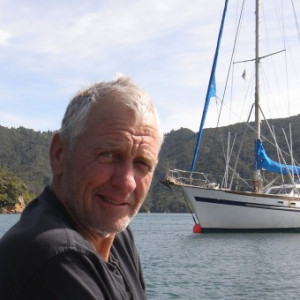
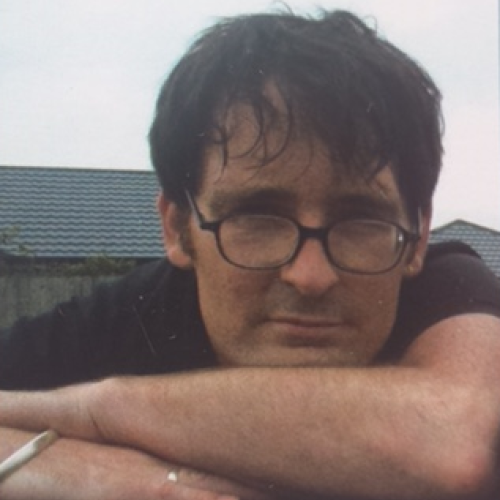
Jim's vision problems started young, when he first needed contact lenses. By the time he turned 21, glasses weren't enough anymore, and the outlook was bleak.
So, in 1974, Jim had his first full-thickness corneal transplant, the most common form of this life-changing procedure that Jim explains with his usual pragmatism: “They just cut the circle out where the cornea is, and sew a new one in.”
It gave him his sight back, but corneal grafts don't always last a lifetime, and over the following decades, Jim needed the procedure twice more – once in each eye – after the original grafts finally wore out, roughly 30 years later.
As Alport syndrome continued to take its toll and the deeper layers of his eyes began to fail in a different way, Jim faced a new kind of surgery altogether: a transplant of the innermost lining of the cornea, the layer of cells that pumps fluid out of the eye and keeps it clear.
He's had this procedure, known as DSAEK (Descemet Stripping Automated Endothelial Keratoplasty), several times since, most recently in 2021, after an earlier graft in the same eye failed.
All up, Jim estimates he's been through around eight eye operations.
Twice, the donor tissue for those transplants had to be shipped in from the United States, because there simply wasn't enough donor tissue available in New Zealand. It's a detail that sits uneasily with Jim, not because of the source, but because it highlights the need for more local donations: “It shows that we don't donate enough.”
Jim’s experience of the power of donation hasn't stopped with his eyesight.
Alport syndrome also damaged his kidneys, and by 2016, Jim was on dialysis. His demanding routine ran close to six hours at a time, several days a week, leaving little room for much else.
Then, one morning, while he was on dialysis, the phone rang. It was his nephrologist. A stranger had walked into Christchurch Hospital and offered one of her own kidneys to whoever needed it. “Even now, just talking about it still gets to me,” Jim says.
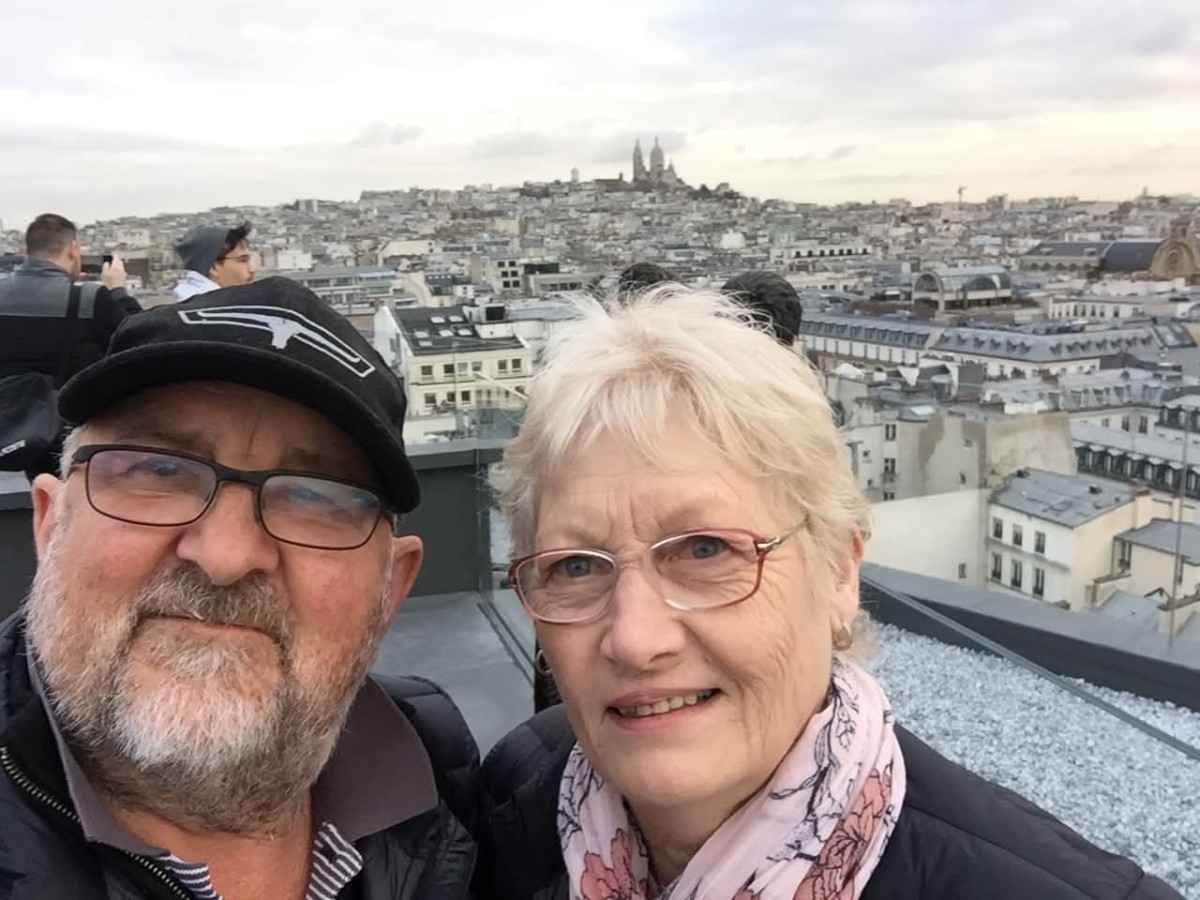
The following year, on a trip to Europe that his poor health had made impossible for years, Jim sent his donor a photo of one of his favourite landmarks anonymously through his transplant coordinator, thanking her for giving him the incredible freedom to travel again.
Married to his wife Rosemary for 53 years, with four daughters and three grandsons that they see regularly, Jim calls himself “a fairly boring person,” but it’s a description that greatly undersells a life built on resilience and gratitude.
His left eye still isn't great, worn down by five operations over the decades, but he's not one to dwell on it. “There are a lot of people getting around with one eye,” he says. “As long as I can look after that one, I'm not too worried.”
Jim is incredibly thankful to the medical professionals who’ve cared for him throughout his journey. “Without their knowledge and expertise, none of this would’ve happened,” he says.
And it's the immense difference his donors’ generosity has made in his life – through his kidney and eyes – that Jim carries with him every day.
For anyone currently waiting for transplant, his advice is simple. “You've just got to hang in there,” he says.
And to anyone considering becoming a donor themselves, Jim’s story is a reminder of just how far that decision can reach, changing not only one person’s life, but the lives of an entire family.